
Ensure Final Payment - The Actions You Can Take
It is common in large projects operating on serious budgets for final payment to be delayed. This is often the payment that contains the contractor's profit. For this, and for the five reasons listed below, having a final payment checklist for each project is important.
Have All Other Party Obligations Been Completed?
Just as the general contractor may have a set of obligations to complete at the end of a project, so too do any sub-contractors, architects or engineers overseeing the project, the project manager, any other parties.
There's more that needs to be done once you have completed your part of the job. You should require sign-off by each party to indicate their obligations are complete and acknowledging that others have done their part so that your payment isn't delayed.
Ensure Mechanics Liens are filed correctly
If there were mechanics liens filed during the project, the project manager will ensure that the liens have been released. This removes any encumbrances on the property for the property owner. You can ensure that all contractors are up-to-date on their payments and serve as a useful reminder for any liens if filed. Signing off on lien paperwork provides another piece of evidence should payments become an issue in the future.
Waiting on money for a job?
Tell us what happened and National Lien & Bond will connect you with an attorney in your state. Free consultation, no obligation.
The Owner and Contractor's Formal "walk-through" List
the owner and contractor generally do a formal "walk-through" when a job is in final stages. The purpose of this ceremony is to generate a list of items that need to be completed before the owner will sign off on the project and ultimately hand over the final check.
Make it your business to know when that formal "walk-through" is happening. More important, is to know what is on that list of final items to be completed and know exactly what needs to happen for you to get paid.
Outline the Time Frame
Clarify the time frame associated with the completing steps, especially if it falls within the responsibility of another party. For items on the final payment checklist, Setting reasonable time frames for the completion of these final steps will help you anticipate when payment should arrive.
Get Approval From Finance
For complex projects, providing a summary sheet of all the work completed on top of the actual documentation, along with each signature, makes the finance administrator's job easier. When they can quickly reference that everything is done and everyone agrees, they can get your check out the door.
National Lien & Bond helps construction companies manage their mechanics lien process
Ensure your entire workflow is smooth and documentation is in order. Your entire staff should understand each step and why it's important. If you have projects in multiple states, the business process of tracking jobs, payments, and liens can get complex. NLB offers an in-depth custom seminar that covers final payment checklists and much more. Fill out the request form to see if your company is eligible to receive a custom lien seminar.
Waiting on money for a job?
Tell us what happened and National Lien & Bond will connect you with an attorney in your state. Free consultation, no obligation.
Related Articles

Conditional Waiver and Release Upon Final Payment
A conditional waiver and release upon final payment only takes effect once payment actually clears. This post compares conditional and unconditional waivers, covers state-regulated forms, and flags the risks contractors face.
Read Article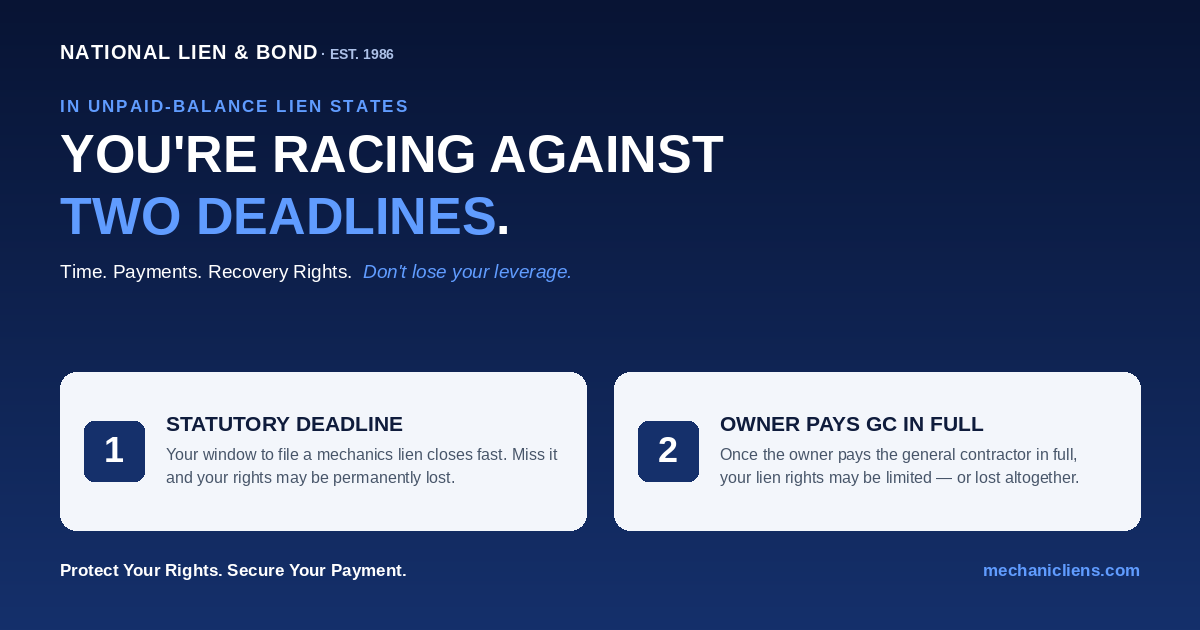
Unpaid-Balance Lien States: Two Deadlines to Track
In an unpaid-balance lien state, the calendar deadline to record your lien is only half the race. The hidden second deadline is the moment the owner finishes paying the general contractor - because that payment can shrink or erase the fund your lien attaches to. This guide explains both deadlines, why subcontractors and suppliers lose money even when they file 'on time,' and the notice-and-timing strategy that protects your leverage.
Read Article
Factoring Companies and Construction Receivables
Factoring can even out cash flow, but it rarely removes your collection risk, and factors secure their advances with a UCC filing against your invoices. This guide explains how factoring works and why you still need to protect your lien and bond rights.
Read Article